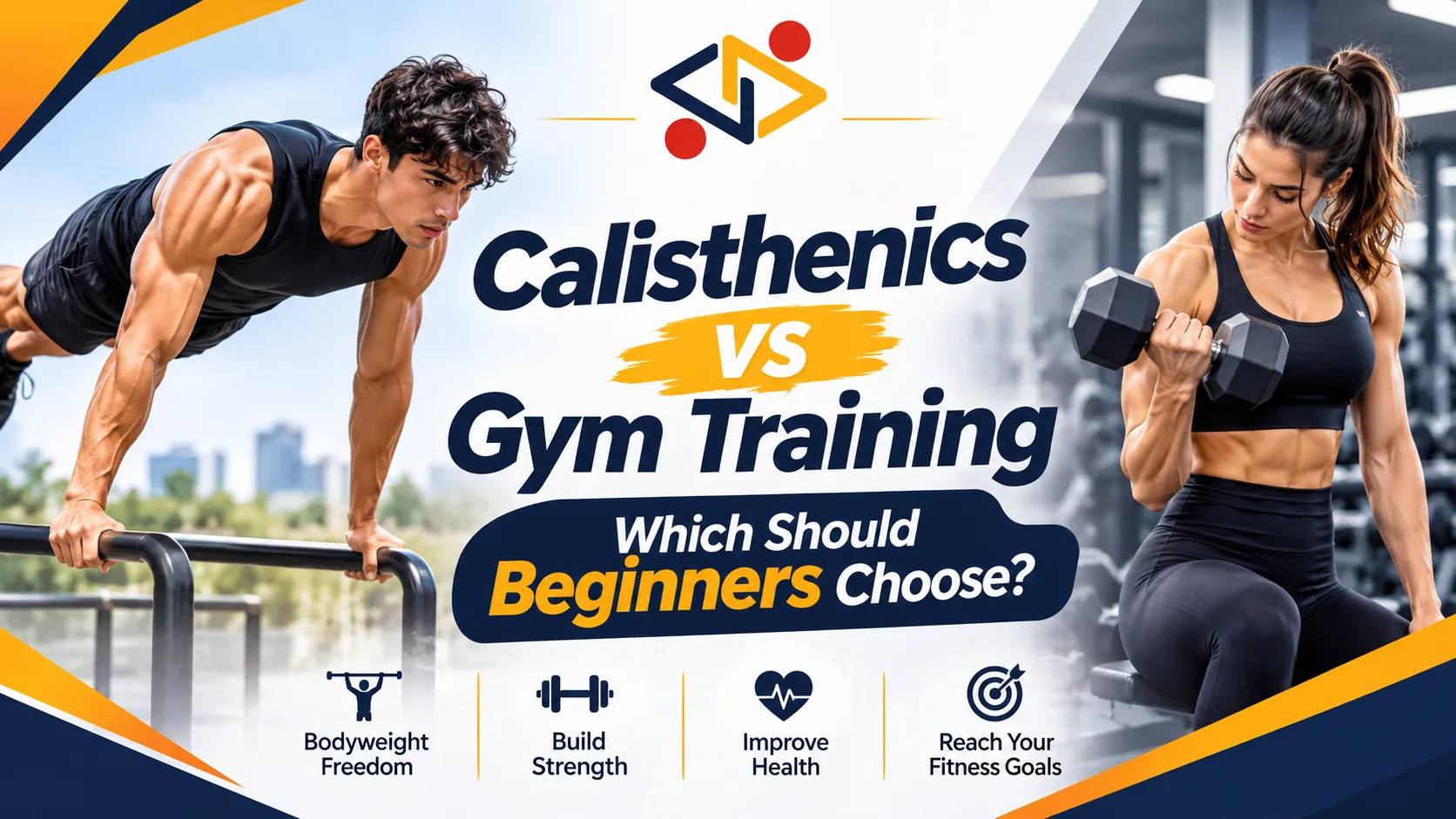
Calisthenics vs Gym Training: Which Should BeginnersChoose?
Walk through any Indian city park at 6 AM and you will see both camps. One group does pull-ups on a bar, push-ups on the grass and handstands against a tree. Another heads into the neighbourhood gym with water bottles and earphones. Both groups are getting fitter. For a beginner, the real question is which route suits you.
Quick answer: For most healthy beginners, calisthenics and gym training both build strength and muscle when you train consistently and make exercises gradually harder. Choose calisthenics if budget, travel or skill goals matter most. Choose the gym if you want heavy leg training, simple tracking or a set place to train. Doing both also works.
This guide compares calisthenics (bodyweight training) and gym training (weights and machines) on muscle gain, cost, convenience, safety and weight loss. It explains what the research does and does not show, and how to start safely.
What is calisthenics, and what counts as gym training?
Calisthenics uses your own body weight as resistance: push-ups, pull-ups, dips, squats, lunges, planks and, later, skills such as handstands and muscle-ups. You make an exercise harder by changing body angle, tempo, range of movement or the number of limbs doing the work, not by adding plates.
Gym training is a form of resistance training that uses external loads: dumbbells, barbells, cables and machines. You make an exercise harder by adding weight in small, measurable steps.
Both methods rely on the same principle, progressive overload: gradually asking your muscles to do a little more than they are used to, so they adapt by becoming stronger and, over time, larger. Muscle growth is called hypertrophy.
Can you build muscle with calisthenics as well as with weights?
For the chest and arms, short studies suggest bodyweight training can match weights when the effort or load is similar. The evidence is limited, though, and comes from small groups of young adults.
| Study | Who took part | What was compared | Finding |
|---|---|---|---|
| Kikuchi & Nakazato, 2017 | 18 men aged 19–22 | Push-ups vs bench press at about 40% of one-rep maximum, twice a week for 8 weeks | Similar gains in bench-press strength and in chest and triceps muscle thickness |
| Calatayud et al., 2015 | 30 university students with advanced resistance-training experience | Band-resisted push-ups vs bench press at a 6-repetition-maximum load, with similar muscle activity, for 5 weeks | Similar strength gains in both groups |
These studies are encouraging, but they have clear limits. Both were short, both involved young adults, and the first included only men. Neither tested women, older adults or complete beginners of all ages, and both looked only at upper-body pushing exercises. They show that push-ups can work as well as the bench press under the right conditions, not that bodyweight training equals weights for every goal.
The practical catch is loading. Push-ups get easy quickly, so you need harder variations, a weighted vest or resistance bands to keep progressing. Legs are harder still. Many people can do dozens of bodyweight squats, so building serious leg strength without weights needs single-leg work, slow tempos and jumping exercises. This is where gym equipment has a real advantage.
How much strength training and cardio do adults need?
The World Health Organization's 2020 physical activity guidelines recommend that adults do muscle-strengthening activities that work all major muscle groups on at least two days a week. Adults should also do 150–300 minutes of moderate-intensity aerobic activity a week, or 75–150 minutes of vigorous-intensity activity, or an equivalent mix of the two, according to the WHO physical activity fact sheet.
The guidelines do not name a training method. In our reading, that means calisthenics, gym training or a mix can all meet the strength recommendation.
Neither calisthenics nor weights alone covers the aerobic part. Add brisk walking, cycling, swimming, sport or other activities that raise your heart rate. Fast calisthenics circuits with short rests can lift the heart rate, but they do not replace regular aerobic exercise.
For adults aged 65 and over, the WHO also recommends varied activity that trains balance and strength on three or more days a week to help prevent falls.
Calisthenics vs gym at a glance
| Factor | Calisthenics | Gym training |
|---|---|---|
| Cost | Low; a park, home or a pull-up bar | Membership fees or equipment costs |
| How you progress | Change body angle, tempo, range or leverage | Add weight in small steps |
| Upper-body strength | Strong option, especially relative to body weight | Strong option |
| Heavy leg and back work | Harder to load heavily | Easier to load heavily |
| Tracking progress | Reps, holds and skill levels | Kilograms and reps |
| Beginners and rehab | Easier variations available | Machines guide the movement |
| Motivation | Skill goals such as the first pull-up | Clear numbers that go up |
Cost
Calisthenics can be almost free: a park with bars, a mat and perhaps a doorway pull-up bar or resistance bands at home. Gym fees vary widely across India. As one published example, the DDA Dwarka Sports Complex, Sector 17, pay-and-play schedule lists gym charges for non-members of ₹4,155.51 for a month or ₹22,245.77 for a year, including GST (checked November 2026; fees may change). Private gyms may cost more or less depending on facilities. Coached calisthenics classes also charge fees but usually need less equipment.
Convenience
Calisthenics can be done almost anywhere, which helps people who travel or work irregular hours. Gyms have fixed hours and a commute, but they also offer a routine and an environment that some people need to stay consistent.
Skill and motivation
Calisthenics has a built-in skill ladder: the first pull-up, the first handstand, the first muscle-up. Many people find these goals more motivating than adding 2.5 kg to a lift. Others prefer the clear numbers of gym training.
Safety
Both are safe for most healthy adults when you progress sensibly. Calisthenics injuries commonly involve the wrists, elbows and shoulders, often after jumping to advanced skills too early. Gym injuries commonly follow poor technique under heavy load. In both cases, learning good form from a qualified coach or trainer is one of the best protections.
Calisthenics vs gym for weight loss
Neither method is clearly better for weight loss on its own. Fat loss depends mainly on your overall eating pattern and how active you are across the whole week. Strength training of either kind helps you keep and build muscle while you lose fat, and regular aerobic activity adds to the energy you use.
For most people, the best combination is the strength method they enjoy, done at least twice a week, plus regular aerobic activity and sustainable changes to what they eat. Choose the option you are most likely to keep doing.
Which should you choose?
| If you… | Start with |
|---|---|
| Have a tight budget or travel often | Calisthenics |
| Want to build large legs or maximal strength | Gym, or a mix of both |
| Are returning from injury | Gym machines or guided rehabilitation, after clearance from your doctor or physiotherapist |
| Enjoy learning skills | Calisthenics |
| Need structure and a place to go | Gym, or a coached calisthenics group |
| Are over 50 and new to training | Either, after checking with your doctor if you have a health condition; a coach and gym machines can help early on |
If you are 65 or older, include balance exercises as well as strength work, as described in the WHO recommendations above.
Before you start: safety checks
Check with a doctor first if…
The NHS advises adults to speak to a GP first if they have not exercised for some time, or if they have medical conditions or concerns. Get medical advice before starting resistance training if you:
- Have a heart condition, or have had chest pain, fainting or palpitations
- Have high blood pressure, especially if it is not well controlled
- Have diabetes or another long-term condition
- Are pregnant or have recently given birth
- Have had recent surgery, a recent injury or ongoing joint pain
- Take medicines that affect your heart rate, blood pressure or balance
A coach can teach technique, but a coach is not a substitute for medical clearance. Some gyms and trainers use a standard pre-exercise screening questionnaire, such as the PAR-Q+, to decide who should see a doctor first.
Stop exercising and seek help if…
Expect some muscle soreness a day or two after new exercise. This is called delayed-onset muscle soreness (DOMS), and it usually fades as your body adapts. Some symptoms are different. The Faculty of Sport and Exercise Medicine UK advises people to stop, sit down and rest if they get chest pain during activity, and to call emergency services if it does not settle.
Stop exercising and get urgent medical help if you have:
- Chest pain, pressure or tightness
- Severe or unusual shortness of breath
- Fainting, or nearly fainting
- A racing or irregular heartbeat together with chest pain, breathlessness or dizziness
Stop, rest and get medical advice if you have:
- Dizziness, light-headedness or unusual tiredness that does not settle with rest
- Sudden sharp pain in a joint, or pain that does not settle with rest
In India, call 112 for emergencies or 108 for an ambulance in most states. Do not go back to exercise until you have been checked, and see a doctor if any symptom returns.
Training outdoors in Indian heat and air pollution
Outdoor calisthenics is popular in Indian parks, so weather and air quality matter.
- Heat: India's National Disaster Management Authority advises avoiding strenuous activity when it is very hot, avoiding the sun between noon and 3 PM, and drinking water often even when you are not thirsty, as reported in its heatwave advisory. Train early in the morning or in the evening during hot months.
- Air quality: On India's National Air Quality Index, "Poor" air (201–300) can cause breathing discomfort with prolonged exposure, and "Severe" air (401–500) can affect even healthy people. Check the local AQI before training outdoors, and move your session indoors on poor-air days, especially if you have asthma, lung disease or heart disease.
How to progress in calisthenics
Calisthenics progress comes from changing body angle, range and leverage rather than adding weight. This simple ladder covers pushing, pulling and leg exercises:
| Level | Push | Pull | Legs |
|---|---|---|---|
| 1 | Wall push-up | Dead hang (20–30 seconds) | Bodyweight squat |
| 2 | Incline push-up (hands on a bench) | Inverted row (high bar) | Reverse lunge |
| 3 | Knee push-up | Inverted row (lower bar) | Split squat |
| 4 | Full push-up | Band-assisted pull-up | Bulgarian split squat |
| 5 | Deficit or slow-tempo push-up | Negative pull-up (slow lowering) | Assisted pistol squat |
| 6 | Archer or weighted push-up | Full pull-up | Pistol squat |
When to move up a level:
- Repetition exercises: when you can do three sets of 8–12 good repetitions
- Dead hang: when you can hold for 30 seconds, three times, with good shoulder control
- Negative pull-up: when you can do three sets of 3–5 controlled lowerings, each taking about 3–5 seconds
If your form breaks down, go back a level. For inverted rows, use a low bar that is fixed in place, such as a park bar. Never use a household table or anything that could tip or collapse under your weight.
How to progress in the gym
Gym progress is simpler to plan: add a small amount of weight or one more repetition when you can complete your sets with good form. Beginners can often make steady progress for months this way. Machines are useful early on because they guide the movement. Free weights build more coordination and stability as you improve. A qualified trainer can set up a basic programme in one or two sessions.
Warm up before every session
Start each session with a few minutes of warm-up; around 5 to 10 minutes is common practice. Include light cardio, joint circles for the wrists, shoulders and hips, and a few easy sets of your first exercise. Calisthenics places particular stress on the wrists and elbows, so wrist mobility work is worth doing every session.
Common beginner mistakes in calisthenics and the gym
Most beginner mistakes in both methods come down to the same thing: too much, too soon, with too little attention to form.
In calisthenics
- Skipping the basics to chase muscle-ups or front levers
- Training wrists and elbows hard without preparation
- Doing the same number of push-ups for months without progressing
- Neglecting legs because squats feel easy
- Ignoring rest days
In the gym
- Lifting too heavy too soon, with poor form
- Copying advanced programmes from social media
- Training only the "mirror muscles" such as the chest and arms
- Skipping warm-ups
- Never changing the programme
Should you combine calisthenics and gym training?
Many experienced trainees end up combining the two: pull-ups, dips and push-up variations for the upper body, and barbell or dumbbell work for the legs and back. Other bodyweight practices can fit in too; for example, yoga can also build strength without weights and improve mobility. Beginners should start with whichever method they will actually do at least two or three times a week. Consistency matters more than the method.
Your first four weeks
The first month is about learning movements and building the habit, not chasing results. Train three times a week on non-consecutive days. Keep each session to 40–60 minutes, including the warm-up. Choose exercise variations you can do with good form for 8–12 repetitions, and write down what you did.
A sample beginner week of calisthenics
- Day 1: Push-ups (on knees or an incline if needed), inverted rows on a low fixed bar, squats, plank
- Day 2: Rest or a brisk walk
- Day 3: Dead hangs, a pulling exercise at your ladder level (band-assisted pull-ups only once you reach Level 4), lunges, glute bridges, side plank
- Day 4: Rest
- Day 5: Repeat Day 1 with one more repetition per set
- Weekend: An active hobby such as cycling, sport or a long walk
Your week-four check
In week four, test yourself: maximum push-ups, a plank hold, and either maximum pull-ups or dead-hang time. If you train in the gym, record the weight you can lift for eight clean repetitions on a basic exercise. These numbers become your starting point for the next month.
Whichever method you choose, book a session with a qualified coach or trainer in the first fortnight to check your form. A few minutes of correction early on can prevent months of practising a movement slightly wrong.
Sleep, food and recovery
Training only works if your body can recover. Sleep, regular meals and enough water make more difference for beginners than the choice between bars and dumbbells.
- Sleep: Most adults aged 18–60 need seven or more hours of sleep a night, according to the US National Institutes of Health.
- Protein: Needs vary, but spreading protein across the day's meals is a simple habit that supports strength gains. Good sources include dal, paneer, curd, chicken, fish and protein-rich foods such as eggs, nuts and seeds.
- Carbohydrates: Regular meals with carbohydrate sources such as whole grains help fuel your training.
- Rest days: Rest days are part of the plan, not a break from it. Most beginners do well with a day off between strength sessions, especially in the first few months.
For more everyday habits that support recovery, see our simple tips for a healthy lifestyle.
Frequently asked questions
Is calisthenics better than the gym for beginners?
Neither is better for everyone. Calisthenics is cheaper and can be done anywhere, while the gym makes it easier to add load in small steps, especially for the legs. Short studies show push-ups can build upper-body strength and muscle similarly to the bench press. The best choice is the one you will do consistently.
Can you build leg strength without weights?
Yes, up to a point. Once bodyweight squats become easy, you need harder single-leg exercises such as Bulgarian split squats and pistol squats, slower tempos or added load such as a backpack or weighted vest. If your main goal is maximal leg strength, gym equipment makes progress easier to plan.
How long does it take to see results from calisthenics or gym training?
It varies with your starting point, age, sleep, food and consistency. In the studies described above, young adults showed measurable strength gains within five to eight weeks. Many beginners notice that exercises feel easier within the first few weeks, while visible changes in muscle size usually take longer.
How many days a week should a beginner train?
Two to three strength sessions a week on non-consecutive days is a practical start. This meets the WHO recommendation of muscle-strengthening activity on at least two days a week and leaves time to recover. Add aerobic activity on other days.
Is calisthenics or gym training safe for people over 50?
Both can be suitable. If you have a heart condition, high blood pressure, diabetes, joint problems or another health condition, speak to your doctor before starting. Begin with easier variations or guided gym machines, learn technique from a qualified coach, and from age 65 include balance exercises to reduce the risk of falls.
Do I need equipment for calisthenics at home?
You can start with no equipment at all. A mat, a sturdy pull-up bar fixed correctly in a doorway and a set of resistance bands make it easier to progress pulling and pushing exercises. Check that any bar is securely fitted before putting your full weight on it.
Should I train when my muscles are sore?
Mild soreness a day or two after training (DOMS) is common for beginners and usually fades within a few days. Light activity is generally fine, but give sore muscles time to recover before training them hard again. Sharp joint pain, swelling or pain that does not settle is different: stop and get advice from a doctor or physiotherapist.
The bottom line
To get started, check whether you need medical clearance, learn the basic movements with a qualified coach, train two or three times a week and add regular aerobic activity. If you choose the gym, ask for an induction and a basic programme rather than copying routines from social media. If you choose calisthenics, consider joining beginner calisthenics classes in Delhi to learn proper techniques and follow a structured progression plan.
The best training method is the one you will still be doing in a year. Pick the one that fits your life, learn it properly and keep showing up.
Medical disclaimer: This article is for general information only and is not a substitute for personal medical advice. If you have a health condition, are pregnant, are recovering from an injury or have any concerns, speak to a qualified doctor or physiotherapist before starting a new exercise programme.
Swaraj Verma
Swaraj Verma is a certified health and fitness trainer with over 10 years of experience in the fitness and wellness industry and the founder of Fitswaraj.com, a health-focused platform dedicated to promoting sustainable, science-based lifestyles. He holds Bachelor’s and Master’s degrees in Nutrition and Health Sciences and specializes in exercise science, nutrition planning, body transformation, and lifestyle coaching. Over the years, he has successfully trained 50+ fitness models and individuals using personalized, evidence-based methods. Through Fitswaraj, Swaraj focuses on long-term wellness over short-term fitness trends by delivering reliable, expert-driven health content and offering a verified fitness professional listing that helps users connect with trusted trainers and wellness experts.